


Definition of Net Promoter Score
The Net Promoter Score measures the propensity or probability of recommendation of a product, brand or service by its customers or users, through the question: " To what extent would you recommend [company X] to a friend or colleague? "
The answer is given on a scale from 0 ("Not at all") to 10 ("Absolutely").
So we distinguish 3 categories of customers:
 Promoters who answered 9 or 10. They like your company's products and services. They are your brand's loyal customers and ambassadors. They recommend your company to other potential buyers.
 Liabilities who gave a score of 7 or 8, also known as neutrals. They are quite satisfied, but could easily switch to the competition if the opportunity arose. They probably won't generate negative word-of-mouth, but aren't enthusiastic enough to promote them.
 The Detractors who gave a score of 6 or less. They are not particularly delighted with the product or service. So they're unlikely to buy, and could damage your reputation.
How do you calculate your Net Promoter Score?
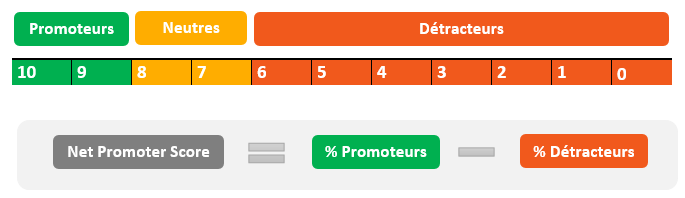
NPS is an absolute number that can range from -100 (where all customers are detractors) to 100 (where all customers are promoters).
The main interests
- It's a simple, high-performance tool that measures improvements in customer loyalty over time.
- It is used worldwide, enabling comparisons with subsidiaries, competitors and other business sectors.
- A sensitive indicator that reacts quickly and makes it easier to see the impact of actions taken.
- A score known by general management, which enables them to mobilize all employees and implement and manage a customer-centric policy.
The main limitations
- The score is sometimes difficult for operational staff to read and take on board. This calls for an educational effort when the system is launched.
- The recommendation question doesn't necessarily work for all industries, products or situations. This may be the case, for example, in a monopolistic market, or in situations where customers have a very limited choice. In such cases, the question can be rephrased and adapted to the particularities of the sector and the corporate culture. The important thing is that the results are correlated with customer loyalty and company growth.
- An indicator that can be reductive and hide different realities. A score of 15, for example, can be the balance of 55% promoters and 40% detractors, or 15% promoters and 0% detractors, combined with a majority of passive customers. The NPS alone is therefore not sufficient to understand the drivers of customer satisfaction, and may lack precision. The results need to be put into perspective and/or supplemented.
Our advice
1. If NPS is the only indicator in your questionnaire
- It is necessary to supplement this with an open-ended question such as "Why / For what reason(s) did you give us this rating?". The NPS question alone is insufficient to understand the reasons for satisfaction and dissatisfaction. And therefore to identify areas for improvement. A reading of the verbatim is therefore necessary to highlight and give meaning to the NPS.
- Complete NPS, with original recommendation percentages (% promoters, % detractors, etc.)
2. Use NPS as one of the indicators in your customer satisfaction survey
In addition to overall satisfaction, intention to buy again or other satisfaction measurement criteria (expectation, quality, commercial relationship, etc.).
3. Taking action
- Promoters Identify them and encourage them to share their experience, and target your sponsorship policy at your customer ambassadors, for example.
- Passives The "soft underbelly" of your customers is harder to work with. The natural objective is to get them to become promoters. This means getting to know them better and investigating this group more closely, to identify what they consider to be a genuinely positive experience.
- Detractors : With automatic dissatisfaction alerts, contact them again to take advantage of the opportunity to turn "the glitch into a nugget", because the most disappointed customers can become the most loyal.
Conclusion
Net Promoter Score is a powerful performance lever. More than just an indicator, it is part of a truly global corporate approach that involves all employees and drives the company towards excellence. To deliver ever more positive customer experiences.
NPS®, Net Promoter® and Net Promoter® Score are registered trademarks of Satmetrix Systems, Inc., Bain & Company and Fred Reichheld.
Did you like this article?
Share it on social networks:
Suggested news

DMA: How the European Union is changing the landscape of online reviews
The field of digital marketing is constantly evolving, shaped by technological advances and current regulations. At the heart of this transformation is the Digital Markets Act (DMA).
Thursday, April 4, 2024

10 marketing opportunities to develop with your customer feedback
Customer satisfaction is at the heart of every successful business. However, collecting and analyzing customer feedback is not only a means of improving the customer experience, it also represents a goldmine for the marketing department.
Friday, December 15, 2023

Sentiment analysis with semantics: understanding customer emotions
With the ever-increasing proliferation of content to examine, semantic analysis is proving to be an invaluable tool, particularly when it comes to customer feedback. It is now even possible to decipher the emotions associated with them. This field is both innovative, promising and highly sensitive.
Friday, September 8, 2023